Interview with Cristian Muñoz Flandez
Updated: 5 days ago

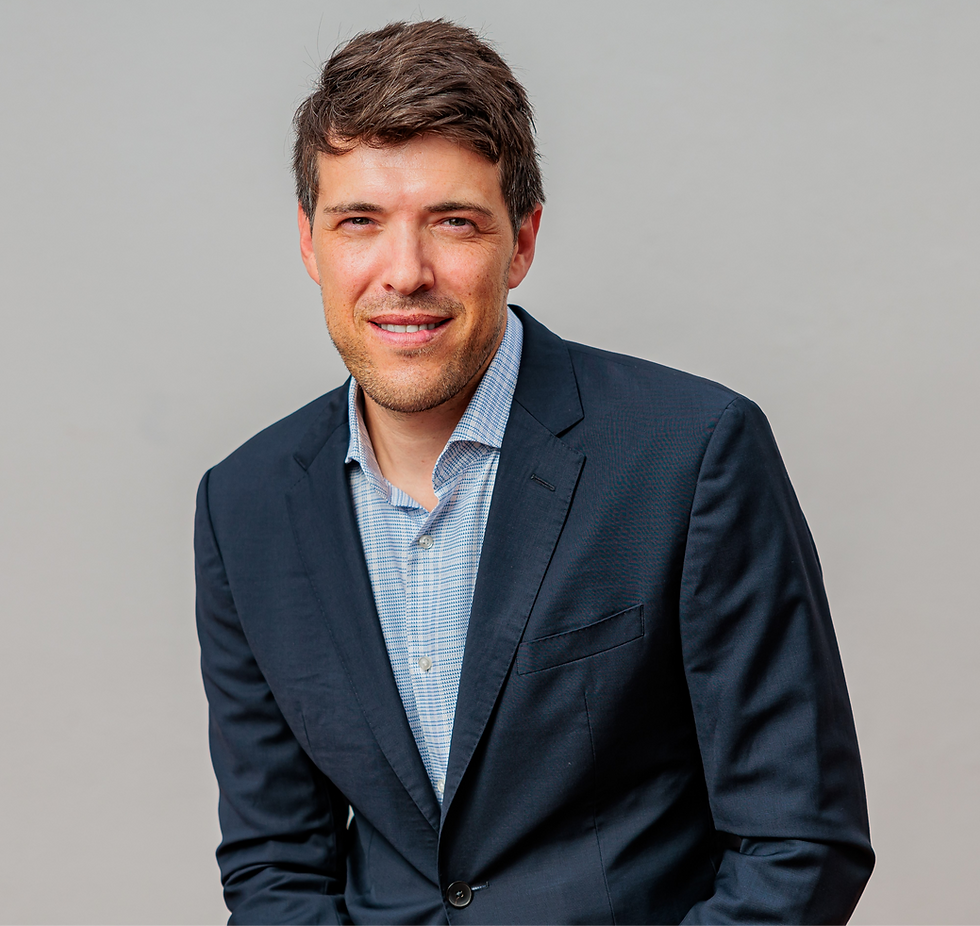
Cristian is a Behavioral Economics Consultant and Professor. As the Behavioral Science Director at Nudge Consulting, he also teaches undergraduate and graduate courses at Pontificia Universidad Católica de Chile and Universidad Adolfo Ibáñez. During his 16-year professional career, he has also designed and evaluated public policies related to education, taxation, and the environment, among other areas. He has held various positions at The World Bank, the Central Bank of Chile, and J-PAL, as well as other national and international institutions. He holds a Master of Public Administration from Columbia University and Master's and Bachelor's degrees in Economics from Pontificia Universidad Católica de Chile.
Who or what got you into behavioural science?
I came into behavioural economics unexpectedly, but I got into economics itself very intentionally. Since childhood, I've had a strong social vocation, though my natural abilities always leaned toward mathematics, so economics was the perfect mix of the two. That vocation comes from where I grew up, a poor municipality in Chile's capital, where I saw firsthand how public policy could help or hurt the people around me, my neighbors, my relatives. Alleviating poverty became my professional goal early on, and economics felt like the way to do it. I did my bachelor's and master's here in Chile, at Pontificia Universidad Catolica de Chile, the same university where I teach today.
From there I followed a fairly conventional economics career, spending eight years at the Central Bank of Chile doing economic research. After all that time, I wanted to make a more direct contribution, to apply research to the real world rather than produce it, so I applied for a Master of Public Administration. I was accepted to Columbia University in New York. I went there to strengthen my economics background, not specifically to study behavioral economics. It was actually a professor I worked with as a research assistant, Cristian Pop-Eleches, who suggested I take a course in Behavioral Development Economics. Before that, I'd never really encountered the field. My professors were Karla Hoff, an economist with many years of experience at the World Bank who led the elaboration of the 2015 World Development Report (themed on Behavioral Economics), and the Nobel Prize laureate Joseph Stiglitz.
The course became the way to bridge a gap I'd always felt: the sense that economics alone could solve every problem, which falls apart the moment you actually go into the field. The following summer, I was accepted for an internship with the behavioural team at the World Bank, and stayed on as a consultant for a couple of years after that.
What is the accomplishment you are proudest of as a behavioural scientist, and what do you still want to achieve?
First, I've bridged the gap between economics and the real world in a way I'm genuinely proud of. I've collaborated on interventions at The World Bank and now consult for public and private organizations at Nudge Consulting.
There, I would like to highlight one project with the Ministry of the Environment in Chile: we won a public tender to improve a home-heating program in Chilean Patagonia, in Coyhaique, one of the most polluted cities in the world, because most people there heat their homes with wood-burning stoves. The program offered a much cleaner stove at a very low price, on the condition that people hand in their old one, but few people took it up, even though it was super cheap.
We traveled there, spoke with residents and public officials, and mapped out the whole journey people go through, from first interest to actually having a new stove installed, to understand where things were breaking down. Culture turned out to be a huge part of it. The wood stove isn't just for cooking; it's where the family gathers, and people genuinely felt its heat was warmer than anything the new technology could offer. We couldn't fight that kind of attachment head-on, but we did find people who wanted the new stove and were getting stuck on more fixable problems, like application friction and weak customer support. So our intervention stayed simple: we rewrote the communication and scripts public officials used to reduce uncertainty, give people a clear timeline, and provide motivation. It was low-cost and minimal, and it still increased the number of new stoves installed by 50 percent over that one season.
The other thing I'm proudest of is teaching. I've been at it for five years now, and I've had the chance to bring behavioural insights to economics students and beyond, like medicine, psychology, anthropology, and law.
What I still want to achieve is a real behavioural community here in Chile, one that doesn't exist yet, especially in the private sector. At Nudge Consulting, we are still working toward that, and it's probably the hardest thing on our plate right now. I'd love to see it happen before I retire, ideally much sooner, but even if I don't get there myself, I'd be happy just knowing my students are carrying these insights into their own careers.
What are the biggest challenges for behavioural science?
The clearest example of behavioral economics in Chile's public sector is the Ministry of the Environment, which built it directly into its legal objectives as a formal tool for improving environmental initiatives. That started about five years ago, and the key ingredient was political support, getting it written into the institution's official toolkit rather than treating it as a side project. We're actually working with the Ministry right now as external consultants through Nudge Consulting. The National Service for the Consumer, which protects consumers' rights, has used it for a long time too, again because of that same political backing.
But there have been just as many failed attempts, for a mix of reasons. There was a real effort to build a dedicated behavioural insights unit in Chile, well-intentioned and promising, but the 2019 Social Unrest shifted government priorities, and its budget was cut entirely. So my honest read is that it only works if you have the political support to embed it in an institution's formal objectives, and in the private sector here it's barely used at all, which makes it even harder to sell projects, because there's no local track record to point to.
What skills would you say are needed to be a behavioural scientist? Any recommendations?
Technical skills are the foundation, the basic offering you bring to the market, but there's no single set of skills that defines a good behavioural scientist. One thing that struck me at the World Bank was that not everyone was an economist. People came from all kinds of disciplines, all grounded in behavioural insights but also bringing very different tools: communications, data science, public policy, UX. My own economics background gives me a particular lens, an understanding of incentives and cost-benefit thinking. That's genuinely useful to combine with behavioural insight, since sometimes the economic incentive matters more and sometimes the behavioural one does, and you need to recognize both.
Bringing those different technical skills together on an interdisciplinary team is, in my experience, the best way to deal with the problems society actually has right now. I'll admit my own bias here: economics, specifically microeconomics, is my favorite foundation to build from, because it's built to explain individual decisions, and you don't have to abandon that grounding; you add behavioural insight as another tool on top of it. It's been genuinely useful for me, even in daily life, to analyze decisions starting from that economic structure of incentives.
How do you think behavioural science and economics will develop in the next 10 years?
In general terms, I think artificial intelligence is where the field is heading. More and more enterprises, in Chile and around the world, will use behavioural science primarily to shape choice architecture inside digital environments, and that's where most of the growth will be.
I hope this triggers an opposite trend as well, one that puts more value back on human factors and human variables. I tell my students constantly that everyone graduating right now is going to be, in some sense, an AI expert, so if that's all they are, they won't be any different from their cohort. Understanding human variables is what will actually set them apart.
There's also a real tension worth naming. Some people argue AI could be the death of behavioural science altogether, depending on the scale of data and the level of black-box personalization you can achieve. Behavioural science is fundamentally about understanding what works, for whom, and why, while AI often doesn't need to care why something works, only that it does. AI will be table stakes for everyone. What I hope to contribute, through both the consultancy and the classroom, is a genuine counterweight to that trend.
What advice would you give to young behavioural scientists, or those looking to progress into the field?
Fewer and fewer people are actually going out into the field anymore; we're all glued to our computers all day, and the small details of human contact -how to talk to people, how to make people connect- are becoming rarer skills. Whoever manages to hold onto them will have a real advantage. People are extremely comfortable behind a screen, building themselves up as influencers, but when they actually have to go out and work with people directly, they often fail, badly, and I think that's only going to get worse.
So my honest message to anyone entering this field is to learn how to talk to people, go out to where they are, listen to them, and build the ability to absorb without judging, so you can see the relationships that artificial intelligence can't see. Beyond that, you need something concrete to bring to the table. The danger of being interdisciplinary is ending up an expert in nothing, so pick something: data science, public policy, UX, communications, psychology, economics. Go deep in it, then bring behavioural insight.
What are your biggest frustrations with behavioural science, as it currently stands?
Honestly, I'm genuinely comfortable with the behavioural community: probably the most comfortable professional community I'm part of, even with its imperfections.
If you weren't a behavioural scientist, what would you be doing?
Before that course at Columbia, I was a fairly traditional economist, and in the version of my life without it, I'd probably still be one, looking for other ways to fight poverty. Outside of economics, I'm a big football (soccer) fan, so I seriously considered being a sports journalist or a football coach. I still play, even now in my 40s, and when I eventually retire, I could see myself training kids, teaching them the game. That feels like a natural second act.
How do you apply behavioural science in your personal life?
I apply it in the classroom in a couple of ways. First, I try to make the classroom a genuinely safe space, where people won't be judged, and I open classes with personal stories, not to make it about me, but to show that behavioural economics applies to everyone's life, including mine. Second, I lean on the humor effect: I try to make the class a fun experience, because relaxed people absorb information better.
The most personal way I apply it, though, is in how I handle sales offers. I'm extremely wary of the classic trick: three months free before a much higher price kicks in. Most people, including plenty of my own students, hear only the first part and forget the rest. So whenever I get a call like that, I ask exactly when the free period ends and set a reminder for that date, so I can decide to keep it or cancel before I'm charged. When I cancel, some companies still call back with new offers. That's how my cable provider has given me premium channels on and off for over ten years.
Which other behavioural scientists would you love to read an interview by?
Jonathan Karver, an economist who has spent more than ten years on the World Bank's behavioural team, where he was my boss for a while. He's worked across a huge range of countries and topics, including tax culture and tax compliance in Eastern Europe. Also, he's genuinely fun, the kind of person who'll talk to you about absolutely anything. I think he'd make a great interview.
Thank you so much for taking the time to answer my questions Cristian!
As I said before, this interview is part of a larger series which can also be found here on the blog. Make sure you don't miss any of those, nor any of the upcoming interviews!


Comments